
Latest Field Notes & Essays
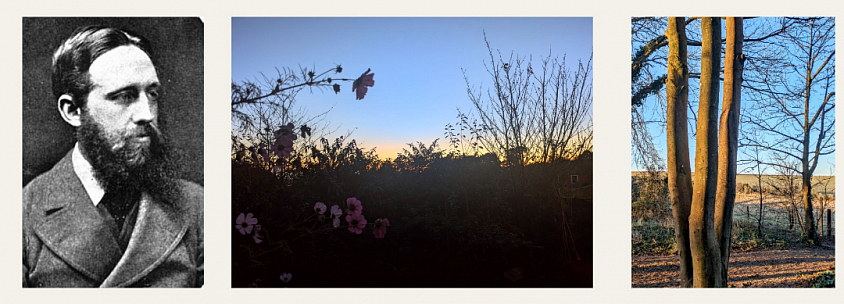
The Lost Leaves Measure Our Years: Autumn Reflections on Richard Jefferies
Storms have been battering our corner of the world for several days now—heavy rain and high winds stripping the last foliage from the trees, just as autumn always insists on doing.
Looking out at this changing landscape, watching lush green give way to bare branches and tall perennials now bowed by the weather, a line by the Victorian nature writer Richard Jefferies comes to mind:
"The lost leaves measure our years; they are gone as the days are gone, and the bare branches silently speak of a new year, slowly advancing to its buds, its foliage, and fruit."
— Richard Jefferies, The Life of the Fields (1884)
It is a poignant reminder that seasonal decay is not just an ending, but a marker of time, continuity, and quiet renewal.
The Writer and the Downs
Born in Wiltshire in 1848, Jefferies began as a local journalist before becoming one of the nineteenth century’s most atmospheric nature writers. He combined a naturalist’s eye with a poetic appreciation for the land.
Later in life, he moved to Sussex, where the high chalk turf and sweeping vistas of the South Downs captivated him. Walking the ridgelines and coastal lanes, he lovingly recorded their subtle shifts through rain, gales, and light—capturing the essence of the Sussex landscape in essays like those found in The Life of the Fields.
Writing Through Suffering
What makes Jefferies’ work so moving is the hardship behind it. For much of his adult life, he suffered from debilitating illness, dying in Goring-by-Sea in 1887 at just 38.
Yet even as his physical health failed, his devotion to the natural world never faltered. Unable to travel far, he spent hours sitting outdoors, meticulously observing the light, the wind, and the resilience of bare trees standing against autumn storms. Writing was not an escape from his pain, but a deep celebration of life’s fleeting beauty.
Solace for Today and the Promise of Spring
Jefferies’ insight offers gentle wisdom for our fast-paced world. When autumn gales arrive and the landscape feels bare, it is easy to focus on loss. But shedding leaves is simply part of the cycle—a necessary clearing away that allows the roots to rest and gather strength.
As the wind rattles the windows today, the second half of Jefferies’ thought brings real hope: those bare branches are already silently preparing for a new year. Autumn storms may strip the canopy today, but they are simply preparing the ground for the turn of the year and the inevitable return of Spring.
A Note for Readers
Do you have a favourite book or nature writer you turn to as the autumn storms settle in?
Measuring the Year in Ten Hours of Daylight
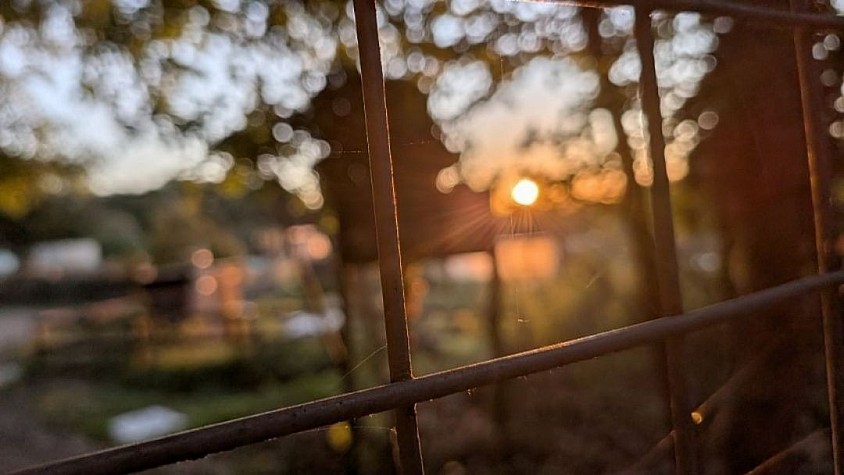
The low autumn sun catching the iron wire—a quiet reminder that even as the cold settles in, the light finds a way to burn golden through the trees.
There is a single word for the weather that I have not needed in half a year, yet this morning on the Sussex coast it arrives with sudden clarity: cold. Four degrees Celsius at dawn, crisp enough to catch in the throat.
Looking back, a sullen, wet start to the year dissolved into a summer that simply blazed. Fifty years on from 1976, this season felt even more relentless—a stretch of intense heat, parched soil, and blinding light. Rain has finally trickled back over the last few weeks, working that small miracle where dead straw stirs and greens again. Yet the land remembers the dry. With official drought warnings close by, we are entering an era that demands new strategies and a quieter vigilance.
Out in the garden, the seasonal choir has thinned, leaving the robin alone at the microphone. Gone is the energetic rush of April; in its place is a melody far more reflective. A sharp tic-tic-tic echoes followed by those delicate, cascading whistles. Unlike the collaborative songs of spring, autumn brings a solitary music: both male and female robins singing apart, carving out separate territories to survive the frost. It is a bittersweet, silvery sound—a hymn to solitude and endurance.
Next week, the clocks turn back, slicing our daylight down to ten short hours. It is not yet the starkest dark of December, but dusk will soon sit at our tables by teatime, pulling the horizon closed a little earlier each day.
A long stretch of cold lies ahead. Yet in this stillness, there is no need for despair. Nature does not close down in autumn; she simply turns inward, holding her breath. The dark is coming, yes, but beneath the soil, spring is already keeping its promise.
The footer, a line of text appearing at the bottom of each page.content and design © Andy Brook 2026A short description of SimDif appears here. You can remove it in Settings after upgrading.Publish